
MIX Profile: DigiBiomics is building AI-powered acoustic testing for lung conditions

Early diagnosis is critical to better patient outcomes, especially when it comes to lung health. Unfortunately for many patients, receiving a diagnosis can take days or weeks, as early symptoms are subjective and easy to dismiss. That often means delayed care and longer illnesses.
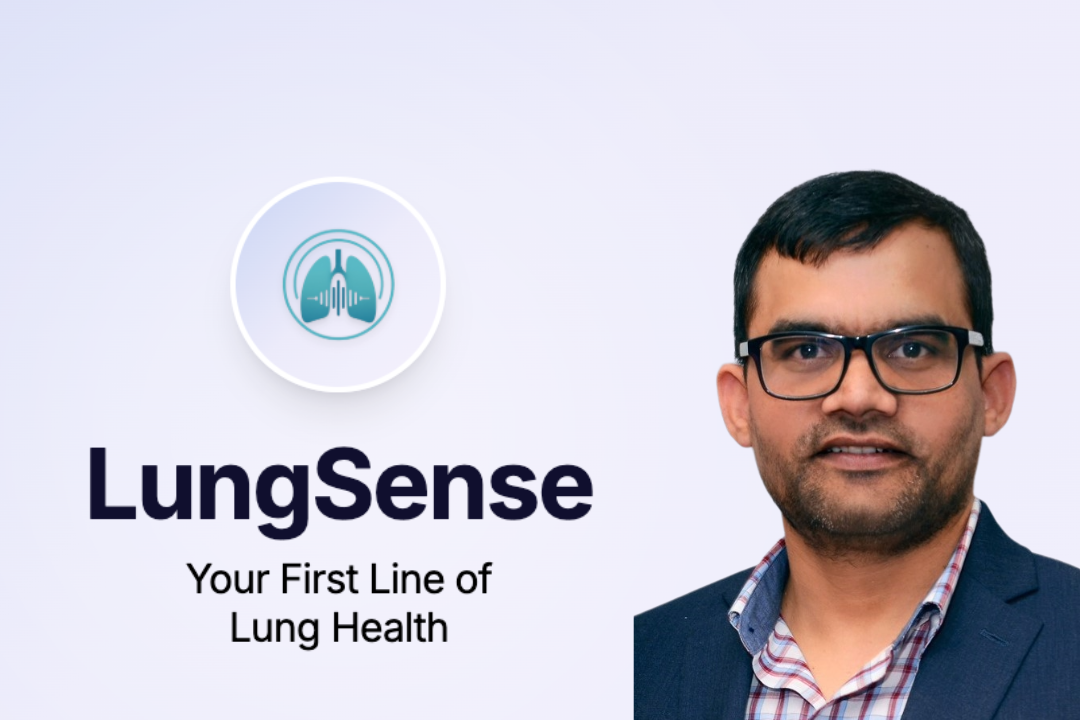
DigiBiomics is working to solve this with LungSense, an advanced respiratory diagnostics platform designed to shift lung health from reactive treatment to proactive prevention. Founded by Dr. Meraj Khan, DigiBiomics has developed LungSense to use artificial intelligence (AI) to analyze cough, breath sounds, and clinical context to detect illnesses earlier and start treatments sooner.
Turning research into impact
Khan is a clinical research scientist by training. Before founding Digibomics, he spent 15 years researching the mechanisms of lung infection and inflammation while working at The Hospital for Sick Children (SickKids) in Toronto. During that time, Khan and his team made multiple discoveries about how the immune system fights infection in the lungs.
“It was a great period of learning and discovery. We published around 35 to 40 research articles and presented our work globally,” he said.
Khan was also selected as a recipient for the Andrew Sass-Kortsak Award at SickKids in 2018, which is given to two exceptional research and clinician-researcher fellows each year.
Then the COVID-19 pandemic and its lockdowns hit the world. Khan’s lab was closed, which was frustrating for more than just putting him and the team on the sidelines of a global health crisis.
“COVID was exactly what my research was about — the lower respiratory tract infection, the immune system triggering, and all the downstream problems that follow. It made me ask what my research was actually doing,” Khan said. “Most published research lives in articles, patents, or poster presentations, but nothing was coming through to help the community. That was the turning point for me — I started thinking about the translational side and how to bring real impact to my community and see my innovation actually help people.”
After the lockdowns ended and Khan was back at SickKids, he moved to its Department of Translational Medicine to pursue ways to make more of an impact for patients. While the work was interesting—drug research, stem cells, and other cutting edge research—Khan still wasn’t satisfied.
His next step? Launching DigiBiomics to turn research into patient impact.
“The purpose of my company is to fast-track innovation and move it from bench to bedside,” he said.
Changing from reactive to proactive
For any disease, early diagnosis can lead to a shorter illness, better treatment, and lead to cost savings for healthcare systems. Khan said the challenge with lung illnesses is that diagnosis almost always relies on reactive care.
“When something happens, we initially ignore it. It could be the flu or just a normal cough. Eventually we go to a walk-in clinic, where the physician isn’t a lung specialist and says it’s been more than a week, so take antibiotics or go for an X-ray,” he said.
It can sometimes take two to three weeks to get a diagnosis. By the time a clinician or family doctor has the correct diagnosis, the window for early, proactive treatment has often passed.
“That’s the problem we want to solve. Bringing preventive care to lung diseases,” he said.
DigiBiomics brings years of research together with analytics, AI, and computational biology to quickly diagnose lung issues as early as possible. The company’s first product in development is LungSense, an early screening and diagnosis tool. Today, the typical way to diagnose lung conditions is by listening to a patient’s breathing using a standard stethoscope.
It’s a subjective process that often misses key markers. LungSense captures and analyzes cough acoustics to provide an objective diagnosis which can help doctors identify issues sooner and order treatment or additional tests.
“X-rays are objective, but by the time you get an X-ray, you’ve already lost those crucial weeks,” Khan said. “Cough acoustics are data anyone can capture at any stage, from children who can’t describe their symptoms to elderly parents in long-term care. That’s the empowerment we want to bring to respiratory care.”
LungSense is designed to be simple. Patients set up a profile with demographic and health history and then enter their current symptoms. The tool then records the patient coughing, which is analyzed and returns a score that indicates the patient’s next action — from taking an over-the-counter medication to calling their family doctor or going to the emergency room
In addition to diagnosing new conditions, LungSense can be used to monitor existing conditions like COPD, emphysema, asthma, and others. Khan said patients with these conditions often experience anxiety around episodic attacks, which can itself trigger an attack.
“Those attacks are very painful, and patients panic — someone might be managing their COPD fine, then suddenly, because of the environment or a lifestyle change, have an attack and need to rush to emergency,” Khan said. “That’s another problem we want to solve, by capturing longitudinal data, the tracking can flag that the patient may be getting close to an attack, so they can take medication like a puffer to prevent it.
Breathing easy starts with the right MIX
DigiBiomics joined MIX as an affiliate company in March 2026 and Khan is already taking advantage of the mentorship and community programs. He said that coming from an academic background, entrepreneurship can be challenging.
“Having the technology or the idea is one thing, but knowing how to take it to the next level and bring it to market is another,” he said. “I’m fortunate to have access to MIX and the larger Canadian healthtech ecosystem.”
Khan has received support in IP and go-to-market strategies, financial modelling, and regulatory pathways.
“At this early stage, I can’t afford to hire experts. MIX has been wonderful in providing that mentorship. MIX is even helping me polish my pitch deck. This is something I’m learning, since it’s not the kind of work I did in my research career, and it means a lot in this journey,” he said.
The company is planning pilot projects to gather real-world data and Khan is in discussions with two long-term care facilities in Ontario. The data will help DigiBiomics fine tune its platform and get it ready to apply for Health Canada approval. In addition to long term care facilities, DigiBiomics has recently signed a letter of intent with the Waterloo Region Health Network for a potential pilot.
“The data also builds credibility and confidence with clients and end users, so they can see the value and decide to buy. That’s our approach — reach the market through piloting and demonstrating impact and cost savings,” Khan said.