

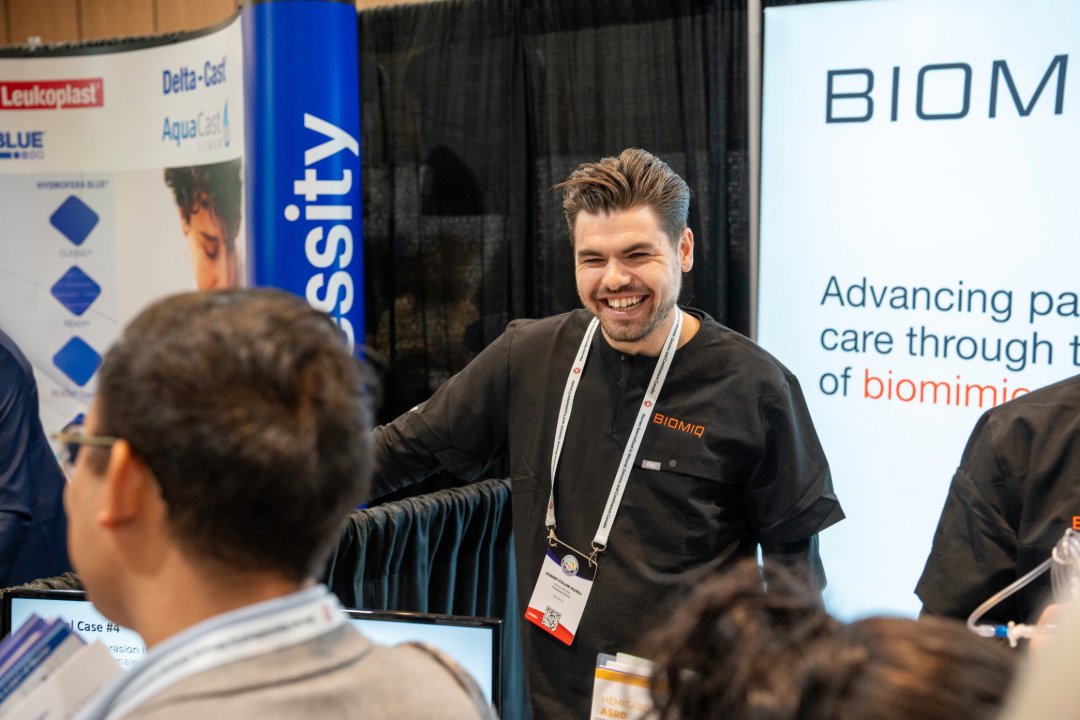

We see medtech innovation in action every day, from next-generation intravascular cameras to surgical navigation tools that are improving patient outcomes across the world.
These new technologies and processes are advancing surgical suites for today and tomorrow. But even with these innovations, if you were to look inside a surgical theatre at your local hospital, you’ll find a technology from the 1830s still in use today.
0.9% saline, or normal saline, has been a part of wound, surgical, and ophthalmological care for almost 200 years. For Rob Fuller, co-founder and managing director of Biomiq, it’s time for an upgrade.
The problem with normal saline
A serial entrepreneur, Fuller spent years looking for impactful healthcare innovations before connecting with a research team tackling the limitations of normal saline.
The challenge he identified was two-fold. While standard antibiotics and antimicrobials are becoming less effective due to increased resistance, saline presents a more fundamental vulnerability: it has never had the ability to kill pathogens.
As bacteria evolve and become harder to fight, relying on an inert solution that merely washes wounds is no longer sufficient.
“Year over year, more patients are dying of resistance to all of these different pathogens,” he says. “We saw an opportunity to change that. ‘Improving patient outcomes’ can be an overused phrase, but we believe it to be true because of the evidence we’ve seen.”
Looking to nature for a solution
To solve this 200-year-old problem, the researchers that Fuller and his team connected with were looking at a source that has been fighting infection for millennia: the human immune system. He says the molecule has been well researched for over 100 years, but it’s only in the last two decades that researchers have been able to create a stable, biomimetic version of what our bodies make naturally.
“They had some fundamental research and really amazing technology, but they were chemists, microbiologists, and geneticists who were struggling to get this product to market,” Fuller says.
After speaking with the researchers, Fuller knew there was a path to market and signed a commercialization agreement for the technology with the founding of Biomiq in 2019. Since then, the company has made a number of innovations and improvements to its line of eye and wound care and infection control products.
“When I came across the molecule that we manufacture today, I was fascinated by its potential applications in almost every area of medicine, from skin and wound care to use in surgeries,” Fuller says.
Biomiq manufactures what Fuller describes as a super-oxidizing saline. Unlike traditional saline, which is simply salt water, Biomiq’s solution contains the same oxidizing molecule our bodies produce naturally to kill invasive pathogens
Because the solution mimics the body’s own biology, it is remarkably versatile. It is safe enough to be used in sensitive areas like the eyes or on the fragile skin of premature infants in the NICU, yet powerful enough to treat chronic wounds like diabetic foot ulcers.
Even more impressive than its versatility is its long term viability in health care.
“It’s a natural antimicrobial,” Fuller explains. “There’s no known resistance to it.”
Delivering improved care around the world
Since launching and receiving Health Canada medical device approval, Biomiq has quickly become a trusted partner for care providers. Its products are used in major hospitals across Canada, including University Health Network (UNH) in Toronto. Biomiq’s products are also offered in contract with Ontario Health.
But while Biomiq is finding traction, Fuller says the company is only beginning to make an impact.
“Our mission is to replace saline as a surgical irrigation and cleansing solution in all areas of medicine,” he says. “We’re quickly moving in that direction with key surgical teams and institutions doing large randomized clinical trials on our product. This is the kind of research that is going to set things up for the next era of how we manage wound and surgical infections going forward.”
That next era includes a major push into international markets. The company is currently working toward FDA approval and is seeing significant interest from Europe and Brazil. Because Biomiq’s solution can be produced in industrial quantities at a very low cost, it is uniquely positioned to help.
“That’s really our goal over the next decade,” Fuller says. “To expand the manufacturing base in every corner of the world.”
Every department is its own market
Biomiq has a vision, but the day-to-day reality of introducing a new medical product is still a battle against inertia. Fuller notes that unlike selling capital equipment like robotic arms, selling a consumable like Biomiq’s solution means fighting “strong, held traditions.”
“Old habits die hard,” Fuller says. “Hospitals have been using saline, iodine, and betadine for decades. It takes time to change people’s minds and get them to understand the clinical value. They’re using something that works,, but we have something that works significantly better, and the cost justification is very evident.”
To do this, Biomiq employs a strategy of deep focus. Fuller explains that a hospital is not a single customer, but a collection of distinct environments. By proving success in a specific niche like chronic wounds they can then begin conversations with other departments.
“Once we have success in one department, we can start the conversation with another,” Fuller says.
The MIX advantage
Fuller has known about MIX since attending our launch party in 2019. But after years of keeping his head down to focus on product development and manufacturing, he saw that Biomiq had reached a stage where engaging with the wider ecosystem was essential.
For Fuller, joining MIX is a chance to support a shared vision to keep innovation and intellectual property within the country.
“We’re trying to keep companies in Canada because it’s so critical to our national sovereignty and economic well-being long term,” he says. “I think we’re all driven by that mission.”
There is also a practical, strategic exchange at play. Fuller notes that while Biomiq has established strong inroads with Canadian hospital procurement teams and Group Purchasing Organizations (GPOs), other MIX members have deeper experience in the US market. This allows for a valuable cross-pollination of knowledge.
It also gives Fuller a chance to give back.
“We’ve probably learned some lessons the hard way,” he says. “We can share some of that knowledge with other companies so they might find a faster route to success.”