

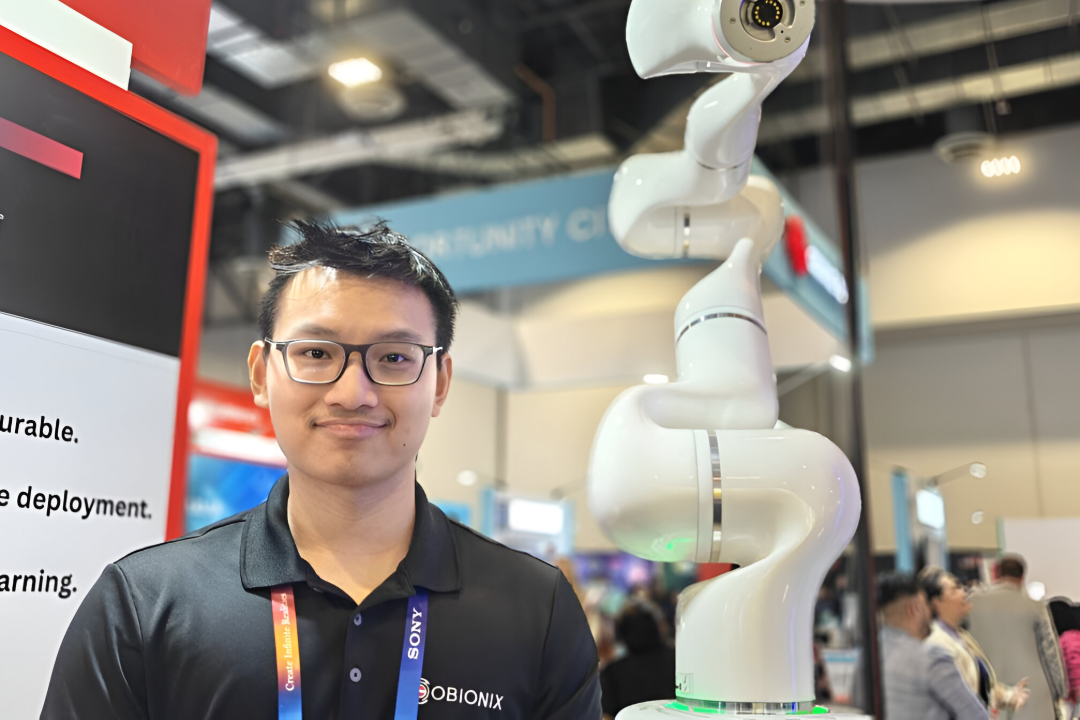

Most medical gadgets are built to solve today’s problems. Cobionix is building the infrastructure for tomorrow’s challenges with a fresh US$3 million investment and a deep bench of Waterloo-bred engineering talent. The team is moving beyond single-use “gadgets” to create a vertically integrated robotic platform to be the standard for a healthcare system that can no longer afford to rely on manual labor alone.
Founded in 2021 by Dr. Tim Lasswell, Nima Zamani, and John Van Leeuwen, Cobionix has developed CODI®, an autonomous medical robotics platform that addresses critical healthcare gaps by performing a wide range of patient-facing clinical tasks.
CEO Matthew Sefati says the company is set up well for its next phase of growth. It closed a US$3 million investment from TitletownTech, a venture fund backed by Microsoft and the Green Bay Packers. Cobionix also added a senior executive from GE Healthcare to its advisory board and has been onboarding engineering and operations talent to support its go-to-market plans in 2026.
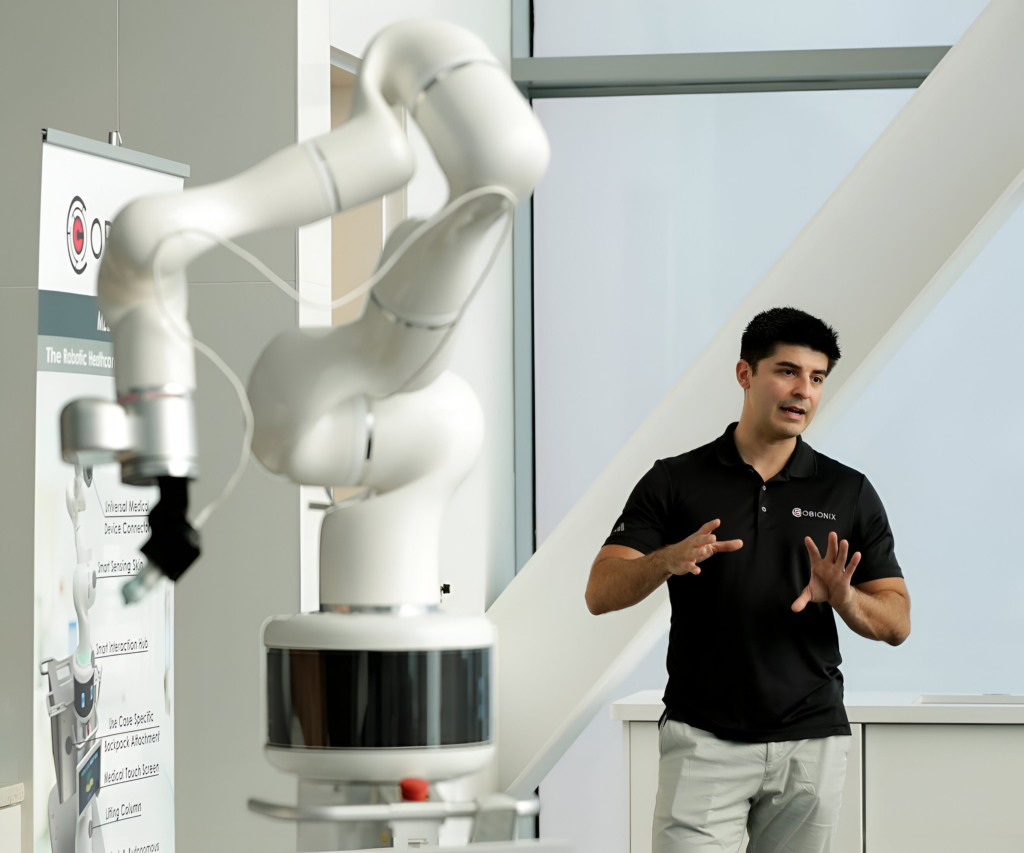
“The investment gives us the resources, network, and expertise to move from pilots to a clear commercialization plan,” Sefati says.“All of this is about building momentum toward 2026, where our focus is to achieve market clearance for CODI in the UK and the US, and be ready to support our customers.”
The robot will see you now
Cobionix started its journey with the development of a robot that was capable of performing an intramuscular injection. Building on that success, Cobionix brought on Sefati to lead the startup from prototyping to commercialization. Today, the CODI® platform is being used by sonographers as they acquire ultrasound images during what Dan Vu, Director of Business Development, says can be repetitive and physically demanding exams.
“Sonographers are the specialists who hold and position the ultrasound probes to acquire images so radiologists and other clinicians can interpret them. They do this all day, often in awkward postures, and over time, many of them develop musculoskeletal (MSK) and repetitive strain injuries (RSI),” Vu says.
CODI takes on the physical strain of the exam. Instead of the sonographer, CODI can hold the ultrasound probe in a fixed position and apply the appropriate pressure for as long as the exam requires. It’s an example of human-led robotics that augments human experience and expertise with robotic stamina.
“The sonographer stays in control of the exam, but the force, posture, and tension are transferred onto CODI,” Vu says. “That improves their day-to-day quality of work, reduces the risk of injury, and helps extend their careers.”
CODI can also be used in a telerobotic mode to bring needed services to rural communities.
“A sonographer in a city center can control a CODI unit in a rural or remote clinic, using the robot to position the probe on a patient who otherwise wouldn’t have access to that level of expertise. That’s a big part of how we see CODI helping close gaps in access to care,” Vu says.
Finding a helping hand at MIX
Cobionix joined MIX in 2024 alongside Hyivy Health. Vu says being part of MIX has helped them in three areas: community, visibility, and network.
“We’re surrounded by other medtech companies that are going through the same regulatory, clinical, and commercialization challenges we are. You don’t have to reinvent the wheel every time. Teams openly share lessons learned, what worked, what didn’t, and that saves you months of trial and error,” Vu says.
The community extends beyond MIX’s walls. Vu says being part of MIX gives the startup visibility with the people shaping the medtech innovation, including government stakeholders and policymakers and fellow medtech leaders.
“Being in a community where everyone is in the same ecosystem, we can tap into each other’s networks when looking for warm introductions to clinicians, entry points into complex healthcare systems, and connections with investors who understand the medtech space,” Vu says.
Like other MIX companies, Cobionix is taking advantage of the space for development and manufacturing. Cobionix even brought in its own CNC equipment to reshore critical parts of its manufacturing process.
“MIX has created space for tenant companies like ours to build out real hardware capabilities. Today, we can prototype, iterate, and produce many components directly on site, which shortens our development cycles and keeps our core know-how close to the team,” Vu says.
From Waterloo to the world
Improving ergonomics and providing telerobotic ultrasounds are just the beginning of Cobionix’s vision of more autonomous robotic exams. Sefati says that the startup’s focus over the next 18 to 36 months is to get CODI approved and into everyday clinical use in the US, UK, and Canada.
“That means finishing our clinical work with our early partners, locking the design for our first indication, and completing the regulatory path so CODI can be deployed as a medical device, not just a research platform,” Sefati says.
Cobionix is also standing up its first wave of commercial-ready systems to validate reliability, serviceability, and workflows.
“Because the CODI platform is vendor-agnostic and works with existing ultrasound machines and infrastructure, hospitals don’t have to replace or purchase new equipment to start benefiting from it,” Sefati says. “When a hospital or imaging group chooses CODI, they’ll be able to install and support it like any other piece of critical equipment.”